


Tuning product selectivity in direct electroreduction of NO via phase engineering of MoS2 nanosheets in a water-fed PEM electrolyzer
 bc
and
Atsushi
Urakawa
*ac
bc
and
Atsushi
Urakawa
*ac
Abstract
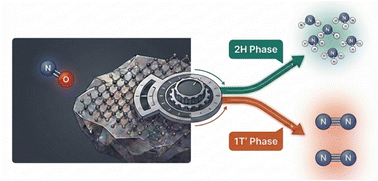
Electrochemical conversion of NO from gaseous pollutants into ammonia using abundant and cost-effective catalyst materials holds great promise for pollutant abatement and for advancing a more closed, sustainable nitrogen cycle. However, regulating product selectivity remains challenging because NO reduction involves complex multielectron/proton pathways. Here, we report two different crystal phases of MoS2 (2H and 1T′) exhibiting prominent activity in the electrochemical NO reduction reaction (NORR), but showing different selectivities. The faradaic efficiency of ammonia reaches 86% over 2H-MoS2, outperforming 1T′-MoS2 (31%) at 2.1 V. In contrast, 1T′-MoS2 displays higher selectivity towards N2, especially at a lower cell voltage (50% at 1.7 V). Kinetic and spectroscopic analyses further suggest phase-dependent rate-control characteristics, consistent with distinct pathway preferences on 1T′ versus 2H. Overall, these results demonstrate that NORR activity and selectivity can be efficiently tuned by choosing the appropriate MoS2 phase, providing a simple strategy to tune product selectivity in complex multistep reactions.
- This article is part of the themed collection: Advances in Sustainable Catalysis: from Materials to Energy and Environmental Applications
 Please wait while we load your content...


