


Earth-abundant metal catalysts for sustainable CO2 reduction: a review of strategies and progress
 *a
Ufana
Riaz
c
*a
Ufana
Riaz
c
Abstract
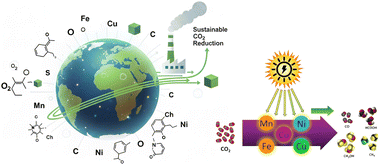
The escalating urgency to address climate change has intensified global interest in technologies capable of converting carbon dioxide (CO2) into value-added products. This review provides an in-depth examination of earth-abundant metals including Cu, Fe, Ni, Zn, Co and Mo as sustainable and economical alternatives to precious-metal systems for CO2 reduction. Unlike earlier reports, this work brings together recent progress in both electrochemical and photocatalytic CO2 conversion, offering a unified perspective on how different reaction environments influence catalyst performance. Emphasis is placed on emerging catalyst architectures such as single-atom sites, dual-atom and alloy configurations, metal–ligand coordinated systems, and advanced hybrid materials. A central theme of this review is the mechanistic challenge associated with C–C coupling and the generation of multi-carbon (C2+) products, an area where single-atom catalysts frequently encounter intrinsic limitations. By integrating recent insights into coordination tuning, multi-site catalytic design and support-induced electronic modulation, we highlight promising strategies to enhance product selectivity and overall catalytic activity. The article also discusses key barriers that continue to hinder large-scale deployment, including limited stability under industrial current densities, site restructuring and deactivation pathways, and mass-transport constraints within practical reactor architectures. Finally, we outline emerging design principles and future research directions that could facilitate the development of durable, high-performance catalysts for sustainable CO2 transformation. Overall, this review provides a comprehensive and forward-looking framework for advancing earth-abundant metal catalysts toward efficient CO2 conversion and the realization of a circular carbon economy.
- This article is part of the themed collection: Sustainable Energy & Fuels Recent HOT Articles
 Please wait while we load your content...


