


Recent progress in electrochemical carbon dioxide reduction using atomically precise copper nanoclusters
 *ab
*ab
Abstract
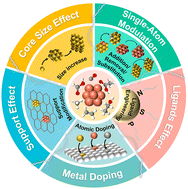
Electrocatalytic carbon dioxide reduction (eCO2RR) is a promising pathway for carbon recycling and clean energy conversion, where catalyst structural engineering plays a critical role in enhancing performance. Metal nanoclusters (NCs), with their atomically precise composition, unique quantum-size effects, and tunable electronic structures, have become a key focus in eCO2RR catalyst research, where significant progress has been made. Herein, recent advances in eCO2RR using NC catalysts are reviewed. This review systematically examines the mechanisms by which the performance of metal NCs in eCO2RR can be modulated, highlighting five key factors: core size effects, single-atom modulation, ligand effects, metal doping, and support effects. The core size directly influences catalytic activity and selectivity by altering the number of active sites and electronic structures. Doping, adding, or removing single atoms enables precise control over electronic states and reaction pathways. Functional ligands optimize activity and stability by modulating the coordination environment, electron transfer, and local microenvironment. Alloying improves performance through interatomic electron transfer and structural symmetry breaking, while the use of supports enhances catalytic outcomes via physical dispersion, electronic modulation, and improved intermediate transport. Finally, recent advances are summarized, and some perspectives in this research direction are provided. This review provides insightful guidelines for the rational design of high-performance electrocatalysts and discusses the challenges and opportunities in this emerging field.
- This article is part of the themed collection: Recent Review Articles
 Please wait while we load your content...


