Experimental and computational investigations of the products of halogenation of 1,2-chalcogenazole 2-oxides

Abstract

The halogenation reactions of 3-methyl-5-phenyl-1,2-tellurazole 2-oxide, benzo-1,2-selenazole 2-oxide and benzo-1,2-tellurazole 2-oxide were investigated in organic solution. The products were identified by single-crystal X-ray diffraction, and characterized by NMR, IR spectroscopies and mass spectrometry. The outcomes of the reactions resulted from one or more of three processes: (i) halogenation of the chalcogen, (ii) protonation, and (iii) halogenation of the heterocycle. Molecules in which the chalcogen was halogenated and protonated behaved as very weak Brønsted acids and displayed a strong affinity for bromide ions, crystallizing with tetraalkyl ammonium cations. In the case of benzo-1,2-selenazole 2-oxide, the heterocycle was chlorinated before the selenium atom. Chalcogen and hydrogen bonding are structural features that determine molecular arrangement in these crystals.
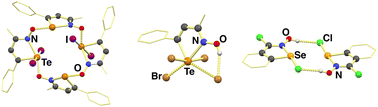
Graphical abstract: Experimental and computational investigations of the products of halogenation of 1,2-chalcogenazole 2-oxides

Supplementary files

Article information

Article type
Paper
Submitted
16 Sep 2025
Accepted
04 Dec 2025
First published
11 Dec 2025
This article is Open Access
Creative Commons BY-NC license

New J. Chem., 2026, Advance Article

Experimental and computational investigations of the products of halogenation of 1,2-chalcogenazole 2-oxides

P. L. MacDougall, M. W. Zeng, J. Z. Wang, P. C. Ho and I. Vargas-Baca, New J. Chem., 2026, Advance Article , DOI: 10.1039/D5NJ03688G

This article is licensed under a Creative Commons Attribution-NonCommercial 3.0 Unported Licence. You can use material from this article in other publications, without requesting further permission from the RSC, provided that the correct acknowledgement is given and it is not used for commercial purposes.

To request permission to reproduce material from this article in a commercial publication, please go to the Copyright Clearance Center request page.

If you are an author contributing to an RSC publication, you do not need to request permission provided correct acknowledgement is given.

If you are the author of this article, you do not need to request permission to reproduce figures and diagrams provided correct acknowledgement is given. If you want to reproduce the whole article in a third-party commercial publication (excluding your thesis/dissertation for which permission is not required) please go to the Copyright Clearance Center request page.

Read more about how to correctly acknowledge RSC content.

Social activity

Spotlight

Advertisements