


Fluoroalkylation of steroid derivatives: synthetic strategies, mechanistic trends, and pharmacological perspectives

Abstract
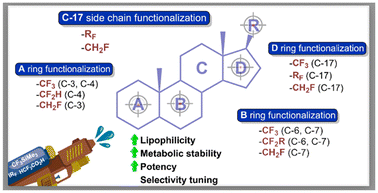
The incorporation of fluorinated substituents into steroidal frameworks represents a valuable strategy for tuning biological and physicochemical properties. This review discusses recent progress in the fluoroalkylation of steroid derivatives, emphasizing synthetic methodologies for the introduction of trifluoromethyl, difluoromethyl, perfluoroalkyl, and partially fluorinated alkyl groups. Advances in nucleophilic, electrophilic, radical, and photoredox-mediated processes have broadened the scope of accessible fluorinated steroids, improving lipophilicity, metabolic stability, and receptor affinity. Representative examples of site-selective functionalization at key positions of the steroid nucleus are discussed, along with mechanistic and methodological insights. Particular attention is given to late-stage transformations enabling efficient access to biologically relevant, structurally complex molecules. Collectively, this work provides a comprehensive overview of current synthetic strategies and highlights the potential of fluoroalkylation chemistry in the design of pharmacologically active steroids.
- This article is part of the themed collection: 2026 Organic Chemistry Frontiers Review-type Articles
 Please wait while we load your content...


