


Atomic-scale structure of gadolinium in nanocrystalline fluorapatite from marine sediments
 *ab
Andrea
Giacomelli,
b
Yan
Li,
a
Anne-Claire
Gaillot,
c
Jianlin
Liao,
a
Alexandre
Simionovici,
e
Andrea
Koschinsky,
f
Stephan N.
Steinmann
*b
*ab
Andrea
Giacomelli,
b
Yan
Li,
a
Anne-Claire
Gaillot,
c
Jianlin
Liao,
a
Alexandre
Simionovici,
e
Andrea
Koschinsky,
f
Stephan N.
Steinmann
*b
Abstract
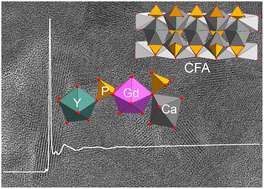
Deep-sea sediments hold large quantities of critical rare earth-elements and yttrium (REY) sequestered in nanoparticulate biogenic fluorapatite (Ca5(CO3)x(PO4)3−xF1+x). Understanding their enrichment processes and improving recovery and mineral processing methods require atomic-scale information about their chemical form, but it is difficult to obtain. Here, we use novel high-energy-resolution fluorescence-detected extended X-ray absorption fine structure (HERFD-EXAFS) spectroscopy to elucidate the local structure of gadolinium (Gd) in the highly enriched REY deposit from the Clarion–Clipperton fracture zone (CCFZ) in the Pacific Ocean. Our findings reveal that Gd is neither incorporated into the apatite structure nor precipitated alongside Ce in a Ce–PO4 precipitate. Instead, it is bound at short-range distances to Ca and PO4 in a defective apatite-type bonding environment within an amorphous matrix that encases fluorapatite nanocrystals. Density functional theory (DFT) suggests that Gd and Y, whose atomic fraction is ten times higher than that of Gd, are not dispersed throughout the amorphous matrix, but are likely segregated at medium-range distances. The entrapment of Ce, Gd, and Y within an amorphous matrix explains, at the microscopic level, why REY can be easily recovered through straightforward acid leaching. This is due to the intrinsic instability of disordered atomic structures compared to crystalline phases. This research highlights the complementarity of HERFD-EXAFS and DFT calculations for atomic-scale analysis of trace elements in complex natural matrices. It establishes a basis for their use across diverse terrestrial and marine materials.
- This article is part of the themed collections: HOT articles from Environmental Science: Nano and Recent Open Access Articles - Environmental Science: Nano
 Please wait while we load your content...


