
Porous confinement: Stable and full exposure of Ru nanoparticles towards efficient electrocatalytic hydrogen evolution

Abstract

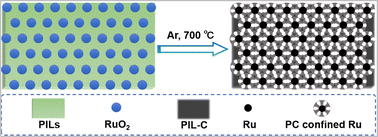
Porous-confined Ru nanoparticles with full accessibility and structural stability are prepared via an in situ pyrolytic etching strategy. The in situ-formed porous-confined structure endows the catalyst with excellent electrocatalytic hydrogen evolution activity and stability, which offers a valuable reference for the design of efficient metal nanocatalysts.
Supplementary files

Article information

Article type
Communication
Submitted
04 Dec 2025
Accepted
09 Feb 2026
First published
10 Feb 2026

Chem. Commun., 2026, Accepted Manuscript

Porous confinement: Stable and full exposure of Ru nanoparticles towards efficient electrocatalytic hydrogen evolution

Q. Qiao, L. Zhang, J. Zhang, W. Zhang, H. Lu, S. Zhu, F. Li, F. Zhang, W. Wei and Y. Zhang, Chem. Commun., 2026, Accepted Manuscript , DOI: 10.1039/D5CC06822C

To request permission to reproduce material from this article, please go to the Copyright Clearance Center request page.

If you are an author contributing to an RSC publication, you do not need to request permission provided correct acknowledgement is given.

If you are the author of this article, you do not need to request permission to reproduce figures and diagrams provided correct acknowledgement is given. If you want to reproduce the whole article in a third-party publication (excluding your thesis/dissertation for which permission is not required) please go to the Copyright Clearance Center request page.

Read more about how to correctly acknowledge RSC content.

Social activity

Spotlight

Advertisements