


Sequential surface synthesis of dispersed sub-nanometer iridium on titanium nitride for acidic water oxidation

Abstract
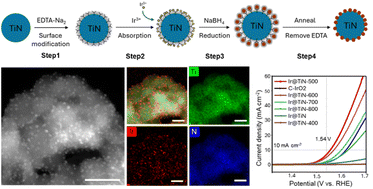
Maximizing iridium utilization while maintaining high oxygen evolution reaction (OER) performance remains a persistent challenge in acidic water electrolysis. Immobilizing Ir on conductive, acid-stable supports is promising, yet simultaneously achieving sub-nanometer size, high area coverage, and strong electronic coupling is difficult. Here, we report a sequential surface synthesis on titanium nitride (TiN) that yields uniformly distributed sub-nanometer Ir arrays (∼0.7 nm). Our method uses ethylenediaminetetraacetic acid (EDTA) as a temporal scaffold: it chemisorbs to TiN to install dense chelating sites, captures Ir3+ ions, and confines Ir cluster growth. A subsequent thermal treatment at 500 °C in a reducing atmosphere removes the ligand shell, while preserving ultrasmall particle size and establishing direct Ir–TiN electronic coupling. The optimized catalyst exhibits mixed Ir0/Irx+ coordination with low charge-transfer resistance (Rct = 19.2 Ω), delivering a mass activity of 342 A gIr−1 at 1.54 V in acidic electrolyte. In situ X-ray absorption spectroscopy reveals irreversible surface oxidation as the primary stability-limiting factor. This stepwise strategy provides a general framework for supported catalysts that maximize precious metal utilization via sub-nanometer dispersion.
- This article is part of the themed collection: Advances in Sustainable Catalysis: from Materials to Energy and Environmental Applications
 Please wait while we load your content...


