


Achieving 57.15% EQE in Mn4+ non-equivalent doped fluoride single crystals via a rapid synthesis for next-generation display lighting

Abstract
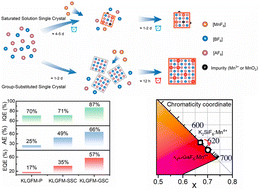
Mn4+ non-equivalent doped fluorides with long-wavelength and narrow-spectrum emission enable ultrawide-gamut display applications. However, existing synthesis schemes result in non-equivalent doped materials with suboptimal quantum efficiency. This study develops a group-substituted single-crystal (GSC) method assisted by a pre-nucleation strategy to achieve the growth of high-quality K2LiGaF6:Mn4+ single crystals with optimal photoluminescence performance and chemical stability. To avoid the adverse effects caused by the long reaction time of Mn4+, the GSC method achieves rapid preparation of K2LiGaF6:Mn4+ single crystals within 12 hours, which is 90% quicker than typical methods and beneficial in preventing the degradation of Mn4+. As a result, K2LiGaF6:Mn4+ not only achieves a high external quantum efficiency of 57.15% but also exhibits excellent stability. A white light-emitting diode (LED) prepared using a blue light chip, commercial green phosphor (β-Sialon:Eu2+) and the optimized KLGFM-GSC can achieve an ultrawide color gamut display of 109.3% National Television Standards Committee (NTSC) or 80.7% Recommendation BT. 2020 (Rec. 2020). In summary, synthesizing single crystals with the GSC method has good universality, opening up new ways for the preparation of high-quality Mn4+ non-equivalent doped fluoride single crystals and promoting the development of ultrawide color gamut display applications.
- This article is part of the themed collection: 2025 Inorganic Chemistry Frontiers HOT articles
 Please wait while we load your content...


