Zhenyuan Ji, Guanxiang Tang, Dongwei Ma, Lizhi Chen, Guoxing Zhu, Jun Zhu and Xiaoping Shen
Inorg. Chem. Front., 2023,10, 406-416
DOI:
10.1039/D2QI02003C,
Research Article


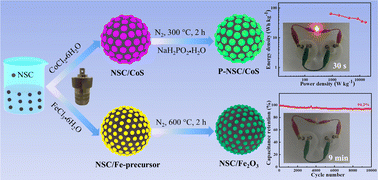
Devising electrode materials with novel configurations and unique properties is a feasible strategy to boost the electrochemical properties of hybrid supercapacitors. This research demonstrates an effective two-step strategy to construct N,S co-doped porous carbon (NSC) sphere supported CoS nanoparticles with phosphate functionalization (P-NSC/CoS). Benefiting from the active multi-components, the electrochemical features of CoS can be remarkably modulated after the NSC and phosphate modifications. As the cathode material for the supercapacitor, the acquired P-NSC/CoS composite delivers a splendid capacity of 436.5 C g−1 at 1 A g−1 and a superb cycling property of 91.5% after 10 000 cycles at 10 A g−1 in 6 M KOH. Furthermore, the Fe2O3 nanocrystals with ultrafine size are in situ deposited on NSC via a solvothermal-calcination process. The NSC/Fe2O3 composite presents a sizeable capacitance of 433 F g−1 at 1 A g−1 with 100.6% capacitance retention after 10 000 cycles. More significantly, it is inspiring that the assembled P-NSC/CoS//NSC/Fe2O3 hybrid supercapacitor delivers an energy density of up to 64.3 W h kg−1 at 873.6 W kg−1 and a splendid cycling stability of 94.2% after 10 000 cycles at 5 A g−1 in 6 M KOH. The appreciable data demonstrate that the prepared advanced electrode materials and the hybrid supercapacitor display excellent application prospects in energy storage.