


14C-labelled nanoplastics reveal size-dependent bioaccumulation in juvenile rainbow trout (Oncorhynchus mykiss)
 †*a
Joyce W. L.
Ang,
b
Gareth T. W.
Law,
b
Ana I.
Catarino,
‡c
Theodore B.
Henry,
c
Steve J.
Rowland,
d
Marc-Andre
Cormier
§e
and
Richard C.
Thompson
a
†*a
Joyce W. L.
Ang,
b
Gareth T. W.
Law,
b
Ana I.
Catarino,
‡c
Theodore B.
Henry,
c
Steve J.
Rowland,
d
Marc-Andre
Cormier
§e
and
Richard C.
Thompson
a
Abstract
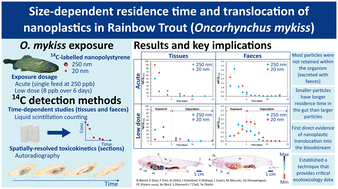
Concerns have been raised about the occurrence of nanoplastics (NP) in the environment. Herein we investigated size-dependent uptake, biodistribution, and egestion of 20 and 250 nm [14C]nanopolystyrene in juvenile rainbow trout (Oncorhynchus mykiss) at environmentally relevant concentrations: a single-day “high-dose” (250 ng gw.w.−1 (∼ppb) fed once) and a 5 day “low-dose” (8 ng gw.w.−1). Following single-day ‘high’ dose exposure, 20 nm particles – but not 250 nm – were detected in internal tissues, indicating translocation across gut endothelia. Rapid depuration returned NP concentrations to control levels within 10 days, with no evidence of accumulation in organs. The presence of 20 nm NPs in circulation suggests temporary vascular transport without parenchymal retention. Translocation of 20 nm NPs across the gut endothelia and association with blood cells should be investigated to determine the cell types involved and the outcome of these associations. These results indicate that uptake-depuration kinetics for [14C]nanopolystyrene in rainbow trout differ from those of other chemical substances (e.g., metals, persistent organic pollutants) and likely have different implications on organism health. The results of this study and the methods developed provide a means of studying and comparing the fate of NPs in organisms such as bivalves and fish.
- This article is part of the themed collections: Nanoplastics in the Environment, Recent Open Access Articles - Environmental Science: Nano and HOT articles from Environmental Science: Nano
 Please wait while we load your content...


