


Microstructure engineered multiphase tellurides with enhanced thermoelectric efficiency
 *a
and
*a
and
Abstract
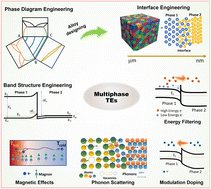
Thermoelectricity is one of the most important and extensively researched ways to recycle waste heat and enable efficient energy conversion without involving any movable parts. Multiphase thermoelectrics (TEs) are found to be better contenders than single-phase TEs, owing to their freedom to tune the interface, phase assemblage, defects, etc. Multiphase TEs provide the advantage of energy filtering, modulation doping, enhanced phonon scattering, higher structural integrity, and magnetic effects over single-phase materials. These engineered microstructural features and atomic arrangements result in a significant effect on the electronic and thermal transport in these materials. Moreover, tellurides among the chalcogenides have gained a lot of attention for their applicability as room-to-medium temperature range TE materials. In the present work, recent advancements in multiphase TEs based on tellurium are reviewed. Thus, this review focuses on some interesting ternary systems (Ag–Bi–Te, Bi–Cu–Te, Bi–Ga–Te, Bi–In–Te, Ga–In–Te, and Sn–Ga–Te) of the Ag–Bi–In–Ga–Sn–Te multicomponent system. Recent advancements in phase diagram engineering, microstructure evolution, processing conditions, and the role of these techniques in optimising the TE performance of multiphase materials belonging to the above-mentioned ternary systems have been discussed.
- This article is part of the themed collections: Thermoelectric energy conversion and Journal of Materials Chemistry A Recent Review Articles
 Please wait while we load your content...


