


Zinc/selenium conversion battery: a system highly compatible with both organic and aqueous electrolytes†
 a
and
Chunyi
Zhi
*ab
a
and
Chunyi
Zhi
*ab
Abstract
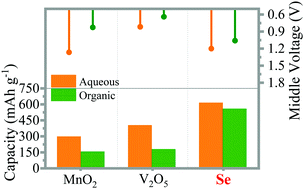
Zinc ion batteries (ZIBs) typically work well in aqueous electrolytes. Most high-performance cathode materials of aqueous ZIBs exhibit much-deteriorated capacity, voltage plateau and rate capability in organic electrolytes. It remains a challenge to have a Zn battery that is highly compatible with both aqueous and organic electrolytes. Herein, a conversion-type Zn–Se battery is constructed, which delivers a superior performance in both organic and aqueous electrolytes benefiting from a highly reversible conversion reaction between Se and ZnSe. Extraordinary capacities in organic systems (551 mA h gSe−1) and aqueous systems (611 mA h gSe−1) were successfully achieved, accompanied by a remarkable rate performance and cycling performance in each of the two systems. In addition, very low voltage plateau slopes, 0.94 V/(A h g−1) and 0.61 V/(A h g−1), are obtained for organic and aqueous systems, respectively, due to the advanced conversion mechanism. These unique features equip these Zn–Se batteries with unprecedented energy densities of up to 581 W h kgSe−1 (290 W h kgSe/CMK-3−1) for the organic system and 751 W h kgSe−1 (375 W h kgSe/CMK-3−1) for the aqueous system. Our research has developed a new Zn battery chemistry that benefits from a conversion mechanism and is highly compatible with both organic and aqueous electrolytes, opening a door for zinc batteries to achieve a higher energy density and better compatibility with various electrolytes.
- This article is part of the themed collection: Battery science and technology – powered by chemistry
 Please wait while we load your content...


