


 PLATFORM UPDATE:


Selective ethylene tetramerization: an overview
 *a
and
Tao
Jiang
*a
*a
and
Tao
Jiang
*a
Abstract
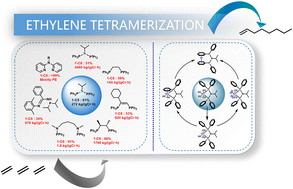
With greater market demand, interest in the selective production of linear α-olefins has been increasing. This review discusses the principles underlying the evolution of the ligand design, co-catalysts, reaction mechanisms, and polyethylene formation in ethylene tetramerization systems over the past few decades, with particular emphasis on the recent use of asymmetric active catalytic centers leading to more competitive performance in selective oligomerization. In general, tetramerization is regulated by the overall spatial crowding of the ligands, as well as by the steric interactions between the donor atoms and the bridge skeletons. Notably, the specific structures of the co-catalysts and the reaction mechanisms remain undefined. Herein, we provide an overview of the history, recent advancements, and future opportunities in the field of selective ethylene tetramerization.
- This article is part of the themed collection: 2023 Inorganic Chemistry Frontiers Review-type Articles
 Please wait while we load your content...


