


A controlled, template-free, and hydrothermal synthesis route to sphere-like α-Fe2O3 nanostructures for textile dye removal
Abstract
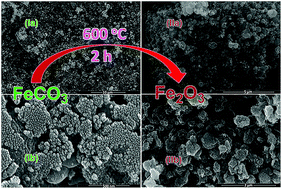
Iron carbonate nanospheres were synthesized via hydrothermal treatment of aqueous solutions of iron sulfate, ascorbic acid and ammonium carbonate with a molar ratio of 1 : 1 : 3, respectively, at 140 °C for 1.5 h. Pure α-Fe2O3 nanoparticles with an average crystallite size of 10.5–32 nm were produced by thermal decomposition of FeCO3 at 400–600 °C for 2 h. The compositions of the products were identified by means of XRD, FE-SEM, HR-TEM, FT-IR, BET, zeta potential and thermal analysis. The adsorption properties of α-Fe2O3 were evaluated using reactive red 195 (RR195) dye. Various parameters influencing the adsorption process were investigated, using a batch technique. The results show that α-Fe2O3 nanoparticles show good adsorption capacity and the dye removal percentage reaches about 98.77% in 10 min. Plus, increasing the surface area of the α-Fe2O3 nanoparticles from 107.7 to 165.6 m2 g−1 increases the adsorption capacity from 4.7 to 20.5 mg g−1. Moreover, the adsorption data fit the Langmuir isotherm model well and the thermodynamic parameters exhibited an endothermic and spontaneous nature for the adsorption of RR195 dye on the hematite adsorbent.
 Please wait while we load your content...


