


A silsesquioxane-based thiophene-bridged hybrid nanoporous network as a highly efficient adsorbent for wastewater treatment†
Abstract
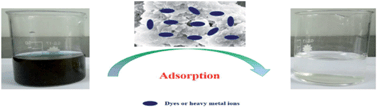
A novel hybrid nanoporous network was easily fabricated by the one-step Heck reaction of octavinylsilsesquioxane with dibromothiophene. FTIR, solid state CP-MAS-NMR (13C and 29Si), and elemental analysis indicate that a thiophene unit has been successfully introduced into the silsesquioxane-based network. The Brunauer–Emmett–Teller (BET) measurement shows that this hybrid network possesses a high surface area of 915 m2 g−1, a large pore volume of 1.61 cm3 g−1, and unique hierarchical pores, i.e. uniform micropores and continuous multimodal mesopores. Remarkably, it displays an ultrahigh adsorption capability of 1402 mg g−1 for Rhodamine B, and 862 mg g−1 for Methylene Blue, which are among the highest values compared with other reported adsorbents. It also shows a good removal capability of toxic heavy metal ions from wastewater. More importantly, it could remove multiple pollutants efficiently from wastewater by simple filtration and possesses excellent regeneration performance.
 Please wait while we load your content...


