


3D ordered macroporous TiO2-supported Pt@CdS core–shell nanoparticles: design, synthesis and efficient photocatalytic conversion of CO2 with water to methane†
Abstract
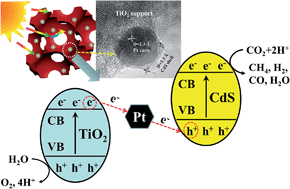
A series of photocatalysts of three-dimensionally ordered macroporous (3DOM) TiO2-supported core–shell structured Pt@CdS nanoparticles were facilely synthesized by the gas bubbling-assisted membrane reduction-precipitation (GBMR/P) method. All the catalysts possess a well-defined 3DOM structure with interconnected networks of spherical voids, and the Pt@CdS core–shell nanoparticles with different molar ratios of Cd/Pt are well dispersed and supported on the inner wall of uniform macropores. The 3DOM structure can enhance the light-harvesting efficiency due to the increase of the distance of the light path by enhancing random light scattering. And the all-solid-state Z-scheme system with a CdS(shell)–Pt(core)–TiO2(support) nanojunction is favourable for the separation of photogenerated electrons and holes because of the vectorial electron transfer of TiO2 → Pt → CdS. 3DOM Pt@CdS/TiO2 catalysts exhibit super photocatalytic performance for CO2 reduction to CH4 under simulated solar irradiation. Among the as-prepared catalysts, the 3DOM Pt@CdS/TiO2-1 catalyst with the moderate thickness of a CdS nanolayer shell shows the highest photocatalytic activity and selectivity for CO2 reduction, e.g., its formation rate of CH4 is 36.8 μmol g−1 h−1 and its selectivity for CH4 production by CO2 reduction is 98.1%. The design and versatile synthetic approach of the all-solid-state Z-scheme system on the surface of 3DOM oxides are expected to throw new light on the fabrication of highly efficient photocatalysts for CO2 reduction to hydrocarbon.
 Please wait while we load your content...


