


Protein-responsive assemblies from catechol–metal ion supramolecular coordination†
Abstract
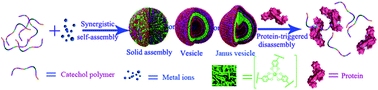
Supramolecular self-assembly driven by catechol–metal ion coordination has gained great success in the fabrication of functional materials including adhesives, capsules, coatings and hydrogels. However, this route has encountered a great challenge in the construction of nanoarchitectures in the absence of removable templates, because of the uncontrollable crosslinking of catechol–metal ion coordination. Herein, we show that a supramolecular approach, combining both catechol–metal ion coordination and polymer self-assembly together, can organize polymers into hybrid nanoassemblies ranging from solid particles, homogeneous vesicles to Janus vesicles. Without the introduction of a specific binding ligand or complicated molecular design, these assemblies can totally disassemble in response to proteins. UV/vis absorption, fluorescence quenching and recovery investigations have confirmed that proteins can seize metal ions from the hybrid nanoassemblies, thus causing the degradation of catechol–metal ion coordination networks.
 Please wait while we load your content...


