


Stress-induced cytotoxicity of chiral Ag nanoclusters†
Abstract
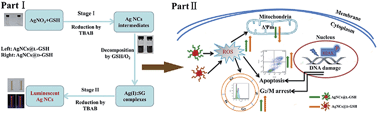
We studied the cytotoxicity of Ag nanoclusters (Ag NCs) capped by the enantiomers L-glutathione (L-GSH) and D-glutathione (D-GSH) synthesized using the mild reduction agent tetrabutylammonium borohydride. The as-synthesized Ag NCs were characterized by HRTEM and UV-visible, photoluminescence and circular dichroism spectroscopy. The circular dichroism spectra of Ag NCs capped with L-GSH and D-GSH showed multiple bands that were identically mirror-imaged, demonstrating that both the metal core and the ligand contributed to the chirality of the GSH-capped NCs. The properties and potential applications of chiral Ag NCs in enantioselective catalysis and chiral recognition and sensing suggest that a comprehensive evaluation should be made of their potential toxicity. We found that Ag NCs capped with D-GSH (AgNCs@D-GSH) were more toxic to both human gastric cancer MGC-803 cells and human gastric mucous epithelial GES-1 cells than Ag NCs capped with L-GSH (AgNCs@L-GSH). Apoptosis also correlated well with the production of reactive oxygen species, mitochondrial membrane depolarization and G2/M cell phase arrest in a dose- and chirality-dependent manner. The in vivo injection of AgNCs@L-GSH and AgNCs@D-GSH into mice bearing human gastric cancer xenografts led to a significant reduction in tumor size and increased apoptosis. This knowledge is important from the perspective of understanding the interactions between chiral nanoclusters and cells.
 Please wait while we load your content...


