


Metal–organic framework derived Fe2O3@NiCo2O4 porous nanocages as anode materials for Li-ion batteries†
Abstract
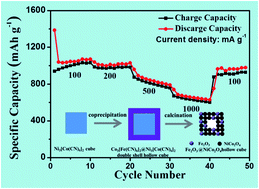
Metal–organic frameworks (MOFs) with high surface areas and uniform microporous structures have shown potential application in many fields. Here we report a facial strategy to synthesize Fe2O3@NiCo2O4 porous nanocages by annealing core–shell Co3[Fe(CN)6]2@Ni3[Co(CN)6]2 nanocubes in air. The obtained samples have been systematically characterized by XRD, SEM, TEM and N2 adsorption–desorption analysis. The results show that the Fe2O3@NiCo2O4 porous nanocages have an average diameter of 213 nm and a shell thickness of about 30 nm. As anode materials for Li-ion batteries, the Fe2O3@NiCo2O4 porous nanocages exhibit a high initial discharge capacity of 1311.4 mA h g−1 at a current density of 100 mA g−1 (about 0.1 C). The capacity is retained at 1079.6 mA h g−1 after 100 cycles. The synergistic effect of the different components and the porous hollow structure contributes to the outstanding performance of the composite electrode.
 Please wait while we load your content...


