This website uses cookies to give you the best user experience. If you continue
without changing your settings we'll assume you are happy to receive all RSC cookies.
You can change your cookie settings by navigating to our Privacy and Cookies page and following the instructions. These instructions
are also obtainable from the privacy link at the bottom of any RSC page.
A DLVO model for catalyst motion in metal-assisted chemical etching based upon controlled out-of-plane rotational etching and force-displacement measurements
School of Materials Science and Engineering, Georgia Institute of Technology, 771 Ferst Drive, Atlanta, USA
E-mail: ohildreth@gatech.edu
b
Department of Mechanical Engineering, Massachusetts Institute of Technology, 77 Massachusetts Avenue, Cambridge, USA
E-mail: konradr@mit.edu
c
Woodruff School of Mechanical Engineering and Petit Institute for Bioengineering and Bioscience, Georgia Institute of Technology, 771 Ferst Drive, Atlanta, USA
E-mail: agf@gatech.edu
d
Department of Electronics Engineering, The Chinese University of Hong Kong Shitan, Hong Kong, China
E-mail: cp.wong@mse.gatech.edu
Nanoscale, 2013,5, 961-970
DOI:
10.1039/C2NR32293E
Received
22 Jun 2012,
Accepted
28 Nov 2012
First published online
04 Dec 2012
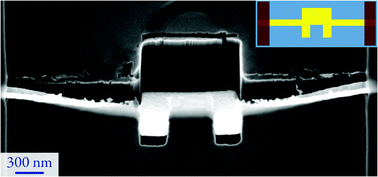
Metal-assisted Chemical Etching of silicon has recently emerged as a powerful technique to fabricate 1D, 2D, and 3D nanostructures in silicon with high feature fidelity. This work demonstrates that out-of-plane rotational catalysts utilizing polymer pinning structures can be designed with excellent control over rotation angle. A plastic deformation model was developed establishing that the catalyst is driven into the silicon substrate with a minimum pressure differential across the catalyst thickness of 0.4–0.6 MPa. Force–displacement curves were gathered between an Au tip and Si or SiO2 substrates under acidic conditions to show that Derjaguin and Landau, Verwey and Overbeek (DLVO) based forces are capable of providing restorative forces on the order of 0.2–0.3 nN with a calculated 11–18 MPa pressure differential across the catalyst. This work illustrates that out-of-plane rotational structures can be designed with controllable rotation and also suggests a new model for the driving force for catalyst motion based on DLVO theory. This process enables the facile fabrication of vertically aligned thin-film metallic structures and scalloped nanostructures in silicon for applications in 3D micro/nano-electromechanical systems, photonic devices, nanofluidics, etc.
Fetching data from CrossRef. This may take some time to load.