


 SCHEDULED MAINTENANCE

Patterning a surface so as to speed nucleation from solution
Abstract
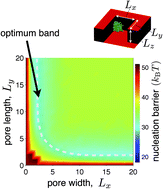
Motivated by the question of how to pattern a surface in order to best speed nucleation from solution, we build on the work of Page and Sear [Phys. Rev. Lett., 2006, 97, 65701] and calculate rates and free energy profiles for nucleation in the 3d Ising model in the presence of cuboidal pores. Pores of well-chosen aspect ratio can dramatically speed nucleation relative to a planar surface made of the same material, while badly chosen pores provide no such enhancement. For a given pore, the maximum nucleation rate is achieved when one of its two horizontal dimensions attains a critical length, largely irrespective of the other dimension (provided that the latter is large enough). This observation implies that
 Please wait while we load your content...


