This website uses cookies to give you the best user experience. If you continue
without changing your settings we'll assume you are happy to receive all RSC cookies.
You can change your cookie settings by navigating to our Privacy and Cookies page and following the instructions. These instructions
are also obtainable from the privacy link at the bottom of any RSC page.
Department of Materials Science and Engineering, Delaware Biotechnology Institute, University of Delaware, Newark, USA
E-mail: xjia@udel.edu
; Fax: +1 302-831-4545
; Tel: +1 302-831-6553
b
Department of Biochemistry and Cell Biology, Rice University, Houston, USA
Soft Matter, 2012,8, 3280-3294
DOI:
10.1039/C2SM06463D
Received
30 Jul 2011,
Accepted
09 Dec 2011
First published online
20 Jan 2012
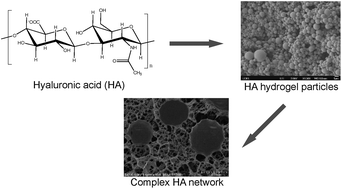
Hyaluronic acid (HA) is one of nature's most versatile and fascinating macromolecules. Being an essential component of the natural extracellular matrix (ECM), HA plays an important role in a variety of biological processes. Inherently biocompatible, biodegradable and non-immunogenic, HA is an attractive starting material for the construction of hydrogels with desired morphology, stiffness and bioactivity. While the interconnected network extends to the macroscopic level in HA bulk gels, HA hydrogel particles (HGPs, microgels or nanogels) confine the network to microscopic dimensions. Taking advantage of various scaffold fabrication techniques, HA hydrogels with complex architecture, unique anisotropy, tunable viscoelasticity and desired biologic outcomes have been synthesized and characterized. Physical entrapment and covalent integration of hydrogel particles in a secondary HA network give rise to hybrid networks that are hierarchically structured and mechanically robust, and capable of mediating cellular activities through the spatial and temporal presentation of biological cues. This review highlights recent efforts in converting a naturally occurring polysaccharide to drug releasing hydrogel particles, and finally, complex and instructive macroscopic networks. HA-based hydrogels are promising materials for tissue repair and regeneration.
Fetching data from CrossRef. This may take some time to load.