



Thermoresponsive nanocomposite double network hydrogels†
Abstract
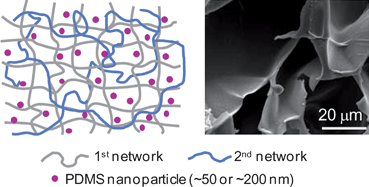
The utility and efficacy of thermoresponsive poly(N-isopropylacrylamide) (PNIPAAm) hydrogels as smart materials is limited by their physical properties. In this study, we sought to design PNIPAAm nanocomposite hydrogels which displayed enhanced mechanical properties as well as deswelling–reswelling kinetics but without reducing equilibrium swelling or altering the convenient volume phase transition temperature (VPTT) of PNIPAAm. PNIPAAm hydrogels were formed as double networks (DN) comprised of a tightly crosslinked 1st network and a loosely crosslinked 2nd network. In addition, polysiloxane
 Please wait while we load your content...


