This website uses cookies to give you the best user experience. If you continue
without changing your settings we'll assume you are happy to receive all RSC cookies.
You can change your cookie settings by navigating to our Privacy and Cookies page and following the instructions. These instructions
are also obtainable from the privacy link at the bottom of any RSC page.
Department of Chemistry, University of Michigan, 930 North University Ave, Ann Arbor, 48109 USA
E-mail: mssanfor@umich.edu
; Fax: +1-734-647-4865
; Tel: +1-734-615-0451
Chem. Sci., 2012,3, 3192-3195
DOI:
10.1039/C2SC20800H
Received
22 Jun 2012,
Accepted
10 Aug 2012
First published online
30 Aug 2012
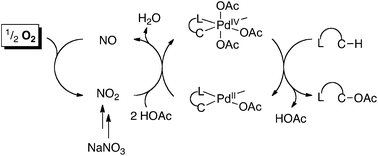
This paper describes a new method for the catalytic aerobic oxygenation of unactivated sp3-C–H bonds. This transformation utilizes Pd(OAc)2 as a catalyst in conjunction with NaNO3 as a redox co-catalyst. Both oxime ether and pyridine derivatives are effective directing groups for these reactions. The oxygen incorporated into the product derives from the solvent (acetic acid). Preliminary results show that the addition of simple NaCl to the reaction mixture results in aerobic chlorination under analogous conditions.
Fetching data from CrossRef. This may take some time to load.