This website uses cookies to give you the best user experience. If you continue
without changing your settings we'll assume you are happy to receive all RSC cookies.
You can change your cookie settings by navigating to our Privacy and Cookies page and following the instructions. These instructions
are also obtainable from the privacy link at the bottom of any RSC page.
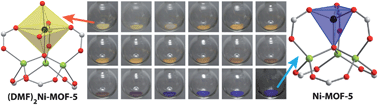
The inorganic clusters in metal–organic frameworks can be used to trap metal ions in coordination geometries that are difficult to achieve in molecular chemistry. We illustrate this concept by using the well-known basic carboxylate clusters in Zn4O(1,4-benzenedicarboxylate)3 (MOF-5) as tripodal chelating ligands that enforce an unusual pseudo-tetrahedral oxygen ligand field around Ni2+. The new Ni-based MOF-5 analogue is characterized by porosity measurements and a suite of electronic structure spectroscopies. Classical ligand field analysis of the Ni2+ ion isolated in MOF-5 classifies the Zn3O(carboxylate)6 “tripodal ligand” as an unusual, stronger field ligand than halides and other oxygen donor ligands. These results may inspire the widespread usage of MOFs as chelating ligands for stabilizing site-isolated metal ions in future reactivity and electronic structure studies.
Fetching data from CrossRef. This may take some time to load.