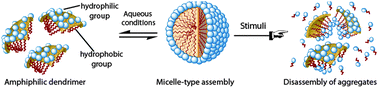
In the past decade, there has been an increasing interest in supramolecular systems that can undergo physical or chemical transformations upon encountering a specific stimulus. Micelle-forming amphiphilic systems based on polymers and dendrimers are particularly preferred over small molecule amphiphiles, due to their ability to sequester and release a vast library of hydrophobic guest molecules at micromolar polymer or dendrimer concentrations. Here we review a relatively underexplored, yet rapidly advancing, field of amphiphilic systems based on a dendritic architecture that exhibit stimuli sensitive behaviour. In particular, we will be focusing on stimuli such as temperature, pH, enzymatic and non-enzymatic proteins. These stimuli-responsive systems offer a unique opportunity in the field of drug delivery and sensing.
You have access to this article
 Please wait while we load your content...
Something went wrong. Try again?
Please wait while we load your content...
Something went wrong. Try again?