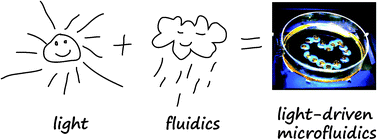
Using light to control liquid motion is a new paradigm for the actuation of microfluidic systems. We review here the different principles and strategies to induce or control liquid motion using light, which includes the use of radiation pressure, optical tweezers, light-induced wettability gradients, the thermocapillary effect, photosensitive surfactants, the chromocapillary effect, optoelectrowetting, photocontrolled electroosmotic flows and optical dielectrophoresis. We analyze the performance of these approaches to control using light many kinds of microfluidic operations involving discrete pL- to μL-sized droplets (generation, driving, mixing, reaction, sorting) or fluid flows in microchannels (valve operation, injection, pumping, flow rate control). We show that a complete toolbox is now available to control microfluidic systems by light. We finally discuss the perspectives of digital optofluidics as well as microfluidics based on all optical fluidic chips and optically reconfigurable devices.
You have access to this article
 Please wait while we load your content...
Something went wrong. Try again?
Please wait while we load your content...
Something went wrong. Try again?