This website uses cookies to give you the best user experience. If you continue
without changing your settings we'll assume you are happy to receive all RSC cookies.
You can change your cookie settings by navigating to our Privacy and Cookies page and following the instructions. These instructions
are also obtainable from the privacy link at the bottom of any RSC page.
Department of Biomedical Engineering, University of Wisconsin-Madison, Madison, USA
b
Division of Biological Sciences, University of California, San Diego, USA
c
Department of Biochemistry, University of Wisconsin-Madison, 471 Biochemistry Addition, 433 Babcock Drive, Madison, United States
E-mail: weibel@biochem.wisc.edu
; Fax: (+608) 265-0764
; Tel: (+608) 890-1342
Lab Chip, 2012,12, 1052-1059
DOI:
10.1039/C2LC20887C
Received
15 Sep 2011,
Accepted
05 Dec 2011
First published online
22 Dec 2011
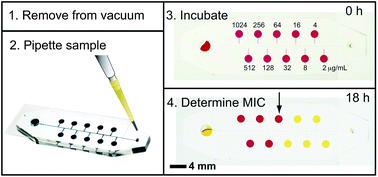
This article describes a portable microfluidic technology for determining the minimum inhibitory concentration (MIC) of antibiotics against bacteria. The microfluidic platform consists of a set of chambers molded in poly(dimethylsiloxane) (PDMS) that are preloaded with antibiotic, dried, and reversibly sealed to a second layer of PDMS containing channels that connect the chambers. The assembled device is degassed via vacuum prior to its use, and the absorption of gas by PDMS provides the mechanism for actuating and metering the flow of fluid in the microfluidic channels and chambers. During the operation of the device, degas driven flow introduces a suspension of bacterial cells, dissolves the antibiotic, and isolates cells in individual chambers without cross contamination. The growth of bacteria in the chambers in the presence of a pH indicator produces a colorimetric change that can be detected visually using ambient light. Using this device we measured the MIC of vancomycin, tetracycline, and kanamycin against Enterococcus faecalis 1131, Proteus mirabilisHI4320, Klebsiella pneumoniae, and Escherichia coli MG1655 and report values that are comparable to standard liquid broth dilution measurements. The device provides a simple method for MIC determination of individual antibiotics against human pathogens that will have applications for clinical and point-of-care medicine. Importantly, this device is designed around simplicity: it requires a single pipetting step to introduce the sample, no additional components or external equipment for its operation, and provides a straightforward visual measurement of cell growth. As the device introduces a novel approach for filling and isolating dead-end microfluidic chambers that does not require valves and actuators, this technology should find applications in other portable assays and devices.
Fetching data from CrossRef. This may take some time to load.