


 SCHEDULED MAINTENANCE


Synthesis and characterisation of oxyanion-doped manganites for potential application as SOFC cathodes
Abstract
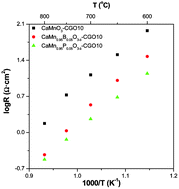
In this paper we report the successful incorporation of borate and phosphate into CaMnO3 and borate into La1−ySryMnO3−δ. For CaMnO3, an increase in the electronic conductivity was observed, which can be correlated with electron doping due to the oxyanion doping favoring the introduction of oxide ion vacancies (as well as the higher valence of P5+ compared to Mn4+ in the case of phosphate doping). The highest conductivity at 800 °C was observed for CaMn0.95P0.05O3−δ, 43.0 S cm−1, in comparison with 7.6 S cm−1 for undoped CaMnO3 at the same temperature. For La1−ySryMnO3−δ the conductivity suffers a decrease for all compositions on borate doping, attributed to a reduction in the hole (Mn4+) concentration. In order to investigate the potential of these materials as SOFC cathodes, the chemical compatibility with Gd0.1Ce0.9O1.95 (CGO10) has also been investigated. For the calcium manganites, the lowest temperature examined without reaction was 900 °C, with minor amounts of Ca4Mn3O10 observed at 1000 °C. Composites of these cathode materials with 50% CGO10 were examined on dense CGO10 pellets and the area specific resistances (ASR) in symmetrical cells were determined. The ASR values, at 800 °C, were 1.50, 0.37 and 0.30 Ω·cm2 for CaMnO3, CaMn0.95B0.05O3−δ and CaMn0.95P0.05O3−δ, respectively. For the lanthanum strontium manganites, the B-doped compositions showed an improvement in the ASR values with respect to the parent compounds, despite the lower electronic conductivity. This may be due to an increase in ionic conductivity due to borate incorporation leading to the formation of oxide ion vacancies. Thus these preliminary results show that oxyanion doping has a beneficial effect on the performance of perovskite manganite cathode materials, and suggests that this doping strategy warrants further investigation in other perovskite cathode systems.
 Please wait while we load your content...
