This website uses cookies to give you the best user experience. If you continue
without changing your settings we'll assume you are happy to receive all RSC cookies.
You can change your cookie settings by navigating to our Privacy and Cookies page and following the instructions. These instructions
are also obtainable from the privacy link at the bottom of any RSC page.
Journal of Materials Chemistry was published between 1991 and 2012. From issue 1, 2013, it was replaced by three new journals: Journal of Materials Chemistry A, B and C
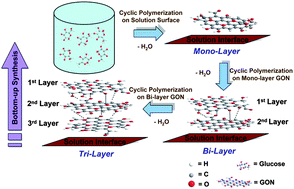
Graphene oxide nanosheets (GONs) have attracted considerable interest due to their potential applications in electronic and optoelectronic devices. Graphene oxide (GO) is usually prepared by using Hummers' method or modified Hummers' methods, which require graphite and strong oxidizers, followed by exfoliation to obtain GONs. The main drawbacks of this top-down approach are the use of strong oxidizing agents and small lateral size of GONs. Here, we present a self-assembly method to synthesize GONs with tunable thickness ranging from 1 nm (monolayer) to 1500 nm. The lateral sizes of the monolayer and few-layer (<5) GONs are about 20 μm and 100 μm respectively. The GONs are prepared by a hydrothermal method using glucose as a sole reagent. The method is environmentally friendly, facile, low-cost as well as capable of scaling up for mass production. The electrical, optical and structural properties of the as-grown and annealed GONs are comparable to GO and reduced GO prepared by the top-down method, respectively. The electrical resistivity of the GONs can be tuned by annealing for 8 orders of magnitude ranging from 106 Ω cm to 10−2 Ω cm. A GO-based photodetector has been fabricated, demonstrating the optoelectronic properties of the GONs.
Fetching data from CrossRef. This may take some time to load.
This may take some time to load.
Journal of Materials Chemistry
- Information Point
This text is added as a work around for heading error in Accessibility testing