This website uses cookies to give you the best user experience. If you continue
without changing your settings we'll assume you are happy to receive all RSC cookies.
You can change your cookie settings by navigating to our Privacy and Cookies page and following the instructions. These instructions
are also obtainable from the privacy link at the bottom of any RSC page.
Department of Chemistry, University of Nevada Las Vegas, Las Vegas, USA
E-mail: poineauf@unlv.nevada.edu
b
Laboratory for Computational Molecular Design, Ecole Polytechnique Fédérale de Lausanne, Institut des Sciences et Ingénierie Chimiques, Lausanne, Switzerland
c
Department of Chemistry and Supercomputing Institute, University of Minnesota, Minneapolis, USA
d
Energy Engineering and Systems Analysis Directorate, Argonne National Laboratory, 9700 Cass Avenue, Lemont, USA
Dalton Trans., 2012,41, 2869-2872
DOI:
10.1039/C2DT11952H
Received
17 Oct 2011,
Accepted
12 Dec 2011
First published online
19 Jan 2012
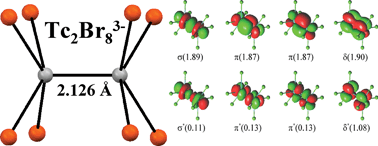
The [Cs(2 + x)][H3O(1 − x)]Tc2Br8·4.6H2O (x = 0.221) salt has been synthesized and characterized by single crystal XRD. Multi-configurational quantum chemical calculations on Tc2X8n− (X = Cl, Br; n = 2, 3) have been performed and indicate the π component in the Tc–Tc bond to be stronger for n = 3.
Fetching data from CrossRef. This may take some time to load.