


 SCHEDULED MAINTENANCE

Vibrationally assisted electron transfer mechanism of olfaction: myth or reality?
Abstract
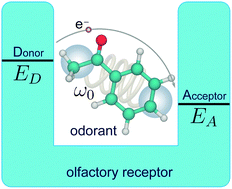
Smell is a vital sense for animals. The mainstream explanation of smell is based on recognition of the odorant molecules through characteristics of their surface, e.g., shape, but certain experiments suggest that such recognition is complemented by recognition of vibrational modes. According to this suggestion an olfactory receptor is activated by electron transfer assisted through odorant vibrational excitation. The hundreds to thousands of different olfactory receptors in an animal recognize odorants over a discriminant landscape with surface properties and vibrational frequencies as the two major dimensions. In the present paper we introduce the vibrationally assisted mechanism of olfaction and demonstrate for several odorants that, indeed, a strong enhancement of an electron tunneling rate due to odorant vibrations can arise. We discuss in this regard the influence of odorant deuteration and explain, thereby, recent experiments performed on Drosophila melanogaster. Our demonstration is based on known physical properties of biological electron transfer and on ab initio calculations on odorants carried out for the purpose of the present study. We identify a range of physical characteristics which olfactory receptors and odorants must obey for the vibrationally assisted electron transfer mechanism to function. We argue that the stated characteristics are feasible for realistic olfactory receptors, noting, though, that the receptor structure presently is still unknown, but can be studied through homology modeling.
- This article is part of the themed collection: Electron Transfer Theory
 Please wait while we load your content...


