



Screening for cocrystals of succinic acid and 4-aminobenzoic acid†
Abstract
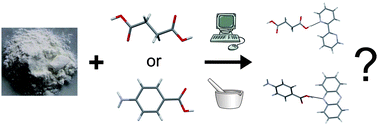
The ability of the pharmaceutically acceptable cocrystallising agents, ![[1 with combining macron]](https://www.rsc.org/images/entities/char_0031_0304.gif) , IV), are reported. The computed crystal energy landscapes of the cocrystals and their components show why succinic acid·1,4-dicyanobenzene did not form a cocrystal as well as predicting the observed structure of succinic acid·2,2′-bipyridine as the most stable. The most stable hypothetical structures of a 1 : 1 succinic acid·1,4-dicyanobenzene cocrystal are closely related to those of the components. The results demonstrate that cocrystal formation requires both hydrogen bonding and close packing, and so markedly non-planar
, IV), are reported. The computed crystal energy landscapes of the cocrystals and their components show why succinic acid·1,4-dicyanobenzene did not form a cocrystal as well as predicting the observed structure of succinic acid·2,2′-bipyridine as the most stable. The most stable hypothetical structures of a 1 : 1 succinic acid·1,4-dicyanobenzene cocrystal are closely related to those of the components. The results demonstrate that cocrystal formation requires both hydrogen bonding and close packing, and so markedly non-planar
- This article is part of the themed collection: Crystal engineering and crystallography in the pharmaceutical industry
 Please wait while we load your content...


