


 SCHEDULED MAINTENANCE:


Adhesive contact between a rippled elastic surface and a rigid spherical indenter: from partial to full contact†
Abstract
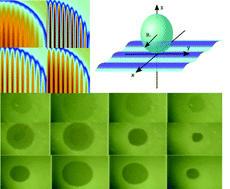
Surface mechanical properties such as adhesion and friction can be controlled by creating a rippled surface. In this paper, we present numerical and experimental studies on adhesive contact between a rippled surface and a rigid spherical indenter. In our numerical method, surface interaction is modeled using Lennard-Jones potential with Derjaguin's approximation. We also carry out a systematic experimental investigation by measuring the adhesion between a spherical glass indenter and rippled polydimethylsiloxane (PDMS) strips with varying amplitudes. With increasing ripple amplitude, our experimental results show a monotonic decrease in pull-off force, transition from full to partial contact, and pressure-sensitive adhesion. Our numerical simulation captures all the salient features of the experimental results remarkably well.
 Please wait while we load your content...


