
This website uses cookies to give you the best user experience. If you continue
without changing your settings we'll assume you are happy to receive all RSC cookies.
You can change your cookie settings by navigating to our Privacy and Cookies page and following the instructions. These instructions
are also obtainable from the privacy link at the bottom of any RSC page.
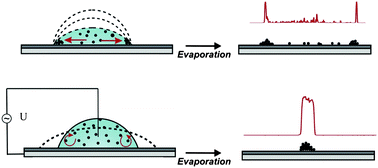
We study the influence of electrowetting on the formation of undesired solute residues, so-called coffee stains, during the evaporation of a drop containing non-volatile solvents. Electrowetting is found to suppress coffee stains of both colloidal particles of various sizes and DNA solutions at alternating (AC) frequencies ranging from a few Hertz to a few tens of kHz. Two main effects are shown to contribute to the suppression: (i) the time-dependent electrostatic force prevents pinning of the three phase contact line and (ii) internal flow fields generated by AC electrowetting counteract the evaporation driven flux and thereby prevent the accumulation of solutes along the contact line.
Fetching data from CrossRef. This may take some time to load.