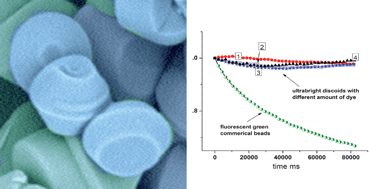
The templated sol–gel synthesis of ultrabright fluorescent nanoporous silica particles based on the use of organic silica sources has previously been reported. The use of organosilanes as the main silica precursors has a number of issues, in particular, the low robustness of the synthesis due to instability of the organic silica source. Here we report on a novel synthesis of ultrabright fluorescent nanoporous silica discoids (a specific shape in-between the sphere and disk) of 3.1 ± 0.7 microns in size, which were prepared using a stable inorganic sodium silicate silica source. Organic fluorescent dye Rhodamine 6G (R6G) was physically (non-covalently) entrapped inside cylindrical nanochannels of ∼4–5 nm in diameter. In contrast to the synthesis with organic silica precursors, the obtained particles showed an excessive leakage of dye. To prevent this leakage, we modified the synthesis by adding a small amount of a secondary silica source. The synthesized particles show virtually no leakage, high photostability, and a brightness equivalent to the fluorescence of up to 7 × 10⁷ free R6G molecules. This is about 7 times higher than the fluorescent brightness of particles of the same size made of CdSe/ZnS quantum dots, and 420 times higher than the brightness of the same volume of aqueous solution of free R6G dye.
You have access to this article
 Please wait while we load your content...
Something went wrong. Try again?
Please wait while we load your content...
Something went wrong. Try again?


 SCHEDULED MAINTENANCE


