


 SCHEDULED MAINTENANCE


Bio-inspired, efficient, artificial lung employing air as the ventilating gas
Abstract
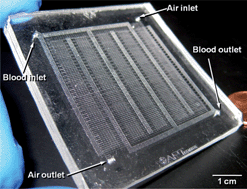
Artificial lungs have recently been utilized to rehabilitate patients suffering from lung diseases. However, significant advances in gas exchange, biocompatibility, and portability are required to realize their full clinical potential. Here, we have focused on the issues of gas exchange and portability and report a small-scale, microfabricated artificial lung that uses new mathematical modeling and a bio-inspired design to achieve oxygen exchange efficiencies much larger than current devices, thereby enabling air to be utilized as the ventilating gas. This advancement eliminates the need for pure oxygen required by conventional artificial lung systems and is achieved through a device with feature sizes and structure similar to that in the natural lung. This advancement represents a significant step towards creating the first truly portable and implantable artificial lung systems for the ambulatory care of patients suffering from lung diseases.
 Please wait while we load your content...


