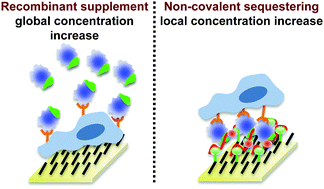
The influence of specific serum-borne biomolecules (e.g.heparin) on growth factor-dependent cell behavior is often difficult to elucidate in traditional cell culture due to the random, non-specific nature of biomolecule adsorption from serum. We hypothesized that chemically well-defined cell culture substrates could be used to study the influence of sequestered heparin on human mesenchymal stem cell (hMSC) behavior. Specifically, we used bio-inert self-assembled monolayers (SAMs) chemically modified with a bioinspired heparin-binding peptide (termed “HEPpep”) and an integrin-binding peptide (RGDSP) as stem cell culture substrates. Our results demonstrate that purified heparin binds to HEPpep SAMs in a dose-dependent manner, and serum-borne heparin binds specifically and in a dose-dependent manner to HEPpep SAMs. These heparin-sequestering SAMs enhance hMSC proliferation by amplifying endogenous fibroblast growth factor (FGF) signaling, and enhance hMSC osteogenic differentiation by amplifying endogenous bone morphogenetic protein (BMP) signaling. The effects of heparin-sequestering are similar to the effects of supraphysiologic concentrations of recombinant FGF-2. hMSC phenotype is maintained over multiple population doublings on heparin-sequestering substrates in growth medium, while hMSC osteogenic differentiation is enhanced in a bone morphogenetic protein-dependent manner on the same substrates during culture in osteogenic induction medium. Together, these observations demonstrate that the influence of the substrate on stem cell phenotype is sensitive to the culture medium formulation. Our results also demonstrate that enhanced hMSC proliferation can be spatially localized by patterning the location of HEPpep on the substrate. Importantly, the use of chemically well-defined SAMs in this study eliminated the confounding factor of random, non-specific biomolecule adsorption, and identified serum-borne heparin as a key mediator of hMSC response to endogenous growth factors.
You have access to this article
 Please wait while we load your content...
Something went wrong. Try again?
Please wait while we load your content...
Something went wrong. Try again?


 SCHEDULED MAINTENANCE