
This website uses cookies to give you the best user experience. If you continue
without changing your settings we'll assume you are happy to receive all RSC cookies.
You can change your cookie settings by navigating to our Privacy and Cookies page and following the instructions. These instructions
are also obtainable from the privacy link at the bottom of any RSC page.
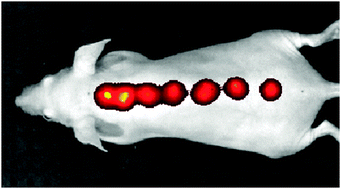
Sodium balance is vital to maintaining normal physiological function. Imbalances can occur in a variety of diseases, during certain surgical operations or during rigorous exercise. There is currently no method to continuously monitor sodium concentration in patients who may be susceptible to hyponatremia. Our approach was to design sodium specific fluorescent sensors capable of measuring physiological fluctuations in sodium concentration. The sensors are submicron plasticized polymer particles containing sodium recognition components that are coated with biocompatible poly(ethylene)glycol. Here, the sensors were brought up in saline and placed in the subcutaneous area of the skin of mice by simple injection. The fluorescence was monitored in real time using a whole animal imager to track changes in sodium concentrations. This technology could be used to monitor certain disease states or warn against dangerously low levels of sodium during exercise.
Fetching data from CrossRef. This may take some time to load.