This website uses cookies to give you the best user experience. If you continue
without changing your settings we'll assume you are happy to receive all RSC cookies.
You can change your cookie settings by navigating to our Privacy and Cookies page and following the instructions. These instructions
are also obtainable from the privacy link at the bottom of any RSC page.
Departamento de Bioquímica y Biología Molecular B e Inmunología, Facultad de Química, Universidad de Murcia, P.O. Box 4021, Murcia, Spain
E-mail: jliborra@um.es
; Fax: (+34) 868884148
; Tel: (+34) 868887398
b
Laboratoire de Chimie et Photonique Moléculaire. UMR CNRS 6510. Université de Rennes-1, Institut de Chimie, UMR-CNRS 6510, Campus de Beaulieu, Av. Général Leclerc, Rennes, France
E-mail: Michel.Vaultier@univ-rennes1.fr
Green Chem., 2011,13, 444-451
DOI:
10.1039/C0GC00230E
Received
18 Jun 2010,
Accepted
15 Dec 2010
First published online
21 Jan 2011
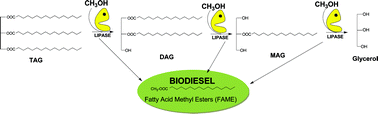
The efficient production of biodiesel in hydrophobic ionic liquids using immobilized lipase was demonstrated. The use of ionic liquids containing long alkyl chains on the cation has the important advantage of producing homogeneous systems at the start of the reaction but, when the reaction is complete, a three-phase system is created that allows selective extraction of the products using straightforward separation techniques, while the ionic liquid and the enzyme can be reused. Fifteen ionic liquids based on different alkyl chain length of the methyl imidazolium cation ([C10MIM], [C12MIM], [C14MIM], [C16MIM] and [C18MIM]) combined with [BF4], [PF6] or [NTf2] anions were assayed as reaction media for two immobilized lipases (Candida antarcticalipase B and Pseudomonas fluorescenslipaseAK) for biodiesel production. The highest synthetic activity was obtained in [C16MIM] [NTf2] using Novozym 435 (immobilized Candida antarcticalipase with 245.13 U g−1IME), its activity being more than three times higher than in a solvent-free system. Additionally, in this IL the fatty acidmethylesters production was 90.29% after 3 h, while in the solvent-free system it was 27.3%. The influence of several reaction parameters, such as temperature, methanol-to-oil molar ratio, alkyl-chain length of the alcohols, IL:substrate volume ratios, amount of enzyme, and oils feedstock were studied and optimized.
Fetching data from CrossRef. This may take some time to load.