



Polarizable energy-storage membrane based on ionic condensation and decondensation†
Abstract
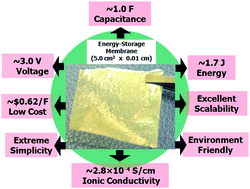
Electrical energy storage and management is an urgent issue due to climate change and energy shortage. Dielectric and double-layer capacitors are the two basic energy-storage devices currently available. However, the application of the dielectric capacitor is very limited due to its low capacitance, while the double-layer capacitor suffers from difficult scaling-up and high fabrication cost, even though its capacitance is high. In this work, we present the first energy-storage membrane which stores charge when simply sandwiched between two metal plates. With an ionic conductivity of 2.8 × 10⁻⁴ S cm−1, the membrane is highly polarizable, and its energy-storage mechanism is based on the condensation–decondensation of mobile
 Please wait while we load your content...


