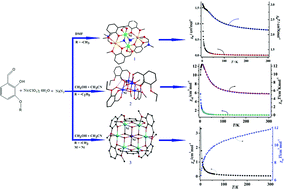
Three polynuclear complexes, [NiNa(μ1,1,1-N3)(μ-hmb)2(DMF)]2, (1), [Ni4(μ3-OMe)4(heb)4(MeOH)1.05(H2O)2.95], (2) and [NiIII(OH)6(hmb)6NiII6]·(ClO4)3 (3) (Hhmb = 2-hydroxy-3-methoxy-benzaldehyde; Hheb = 2-hydroxy-3-ethoxy-benzaldehyde), were prepared by reaction of the appropriate ligand with nickel(II) perchloride hexahydrate under solvothermal conditions. All compounds were characterized by elemental analysis, IR spectroscopy and X-ray single-crystal diffraction. Compound 1 exhibits a centrosymmetric heterotetranuclear cluster which represents the first nickel complex to possess two connected face-sharing cubes structure {Ni2Na2N2O4}. Compound 2 has a tetranuclear Ni cluster with a cubane topology in which the Ni(II) and the oxygen atoms from the methanol ligands occupying alternate vertices of the cube. Compound 3 consisits of a mixed-valence [NiIII(OH)6(hmb)6NiII6]3+ subunits and it represents the first nickel {NiII6NiIII} complex to possess a planar hexagonal disc-like structure. The results show that the minor ligand modifications or solvent change have a key role in the structural control of the self-assembly process. Magnetic properties of 1–3 in the 300–2 K have been discussed. The {Ni2Na2} (1) and {Ni4} (2) core display dominant ferromagnetic interactions from the nature of the binding modes through μ3-N3− or μ3-OCH3−, while {NiII6NiIII} core (3) displays dominant anti-ferromagnetic interactions from the nature of the binding modes through μ3-OH−.
You have access to this article
 Please wait while we load your content...
Something went wrong. Try again?
Please wait while we load your content...
Something went wrong. Try again?