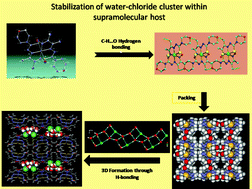
The metal complexes, [M(Hdammthiol)2]Cl·3H2O [M = Cr(III) (1), Fe(III) (2)] [where H2dammthiol is the thiol form of the ligand, diacetylmonoxime morpholine N-thiohydrazone] were synthesized by metal template reactions of diacetylemonoxime with morpholineN-thiohydrazide in the presence of CrCl3·6H2O and FeCl3·6H2O. Both the complexes (1 and 2) were characterized by single crystal X-ray crystallography, spectroscopic (IR and UV-vis), Mössbauer and TGA analyses. The single crystal X-ray studies of both complexes show that the supramolecular hosts, constructed by the discrete mononuclear complexes, form supramolecular channels along the c-axis which are filled up by water–chloride clusters. In both complexes, the 1D water–chloride chain with chair-like architecture within the supramolecular hosts presents novelty. The magnetic measurement study of Fe(III) complex shows a spin crossover from S = 1/2 at 2.5 K to S = 5/2 at 300 K. At very low temperature, the presence of strong cooperative hydrogen bonding interactions stabilizes the S = 1/2 state.
You have access to this article
 Please wait while we load your content...
Something went wrong. Try again?
Please wait while we load your content...
Something went wrong. Try again?