This website uses cookies to give you the best user experience. If you continue
without changing your settings we'll assume you are happy to receive all RSC cookies.
You can change your cookie settings by navigating to our Privacy and Cookies page and following the instructions. These instructions
are also obtainable from the privacy link at the bottom of any RSC page.
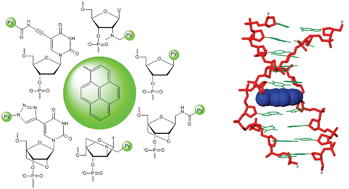
Pyrene-functionalized oligonucleotides (PFOs) are increasingly explored as tools in fundamental research, diagnostics and nanotechnology. Their popularity is linked to the ability of pyrenes to function as polarity-sensitive and quenchable fluorophores, excimer-generating units, aromatic stacking moieties and nucleic acid duplex intercalators. These characteristics have enabled development of PFOs for detection of complementary DNA/RNA targets, discrimination of single nucleotide polymorphisms (SNPs), and generation of π-arrays on nucleic acid scaffolds. This critical review will highlight the physical properties and applications of PFOs that are likely to provide high degree of positional control of the chromophore in nucleic acid complexes. Particular emphasis will be placed on pyrene-functionalized Locked Nucleic Acids (LNAs) since these materials display interesting properties such as fluorescence quantum yields approaching unity and recognition of mixed-sequence double stranded DNA (144 references).
Fetching data from CrossRef. This may take some time to load.