


The global technical and economic potential of bioenergy from salt-affected soils†
Abstract
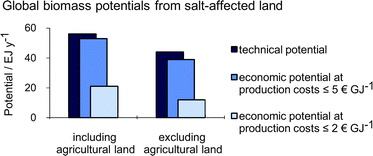
This study assesses the extent and location of salt-affected soils worldwide and their current land use and cover as well as the current technical and economic potential of biomass production from forestry plantations on these soils (biosaline forestry). The global extent of salt-affected land amounts to approximately 1.1 Gha, of which 14% is classified as forest, wetlands or (inter)nationally protected areas and is considered unavailable for biomass production because of sustainability concerns. For the remaining salt-affected area, this study finds an average biomass yield of 3.1 oven dry ton ha−1 y−1 and a global technical potential of 56 EJ y−1 (equivalent to 11% of current global primary energy consumption). If agricultural land is also considered unavailable because of sustainability concerns, the technical potential decreases to 42 EJ y−1. The global economic potential of biosaline forestry at production costs of 2€ GJ−1 or less is calculated to be 21 EJ y−1 when including agricultural land and 12 EJ y−1 when excluding agricultural land. At production costs of up to 5€ GJ−1, the global economic potential increases to 53 EJ y−1 when including agricultural land and to 39 EJ y−1 when excluding agricultural land. Biosaline forestry may contribute significantly to energy supply in certain regions, e.g., Africa. Biosaline forestry has numerous additional benefits such as the potential to improve soil, generate income from previously low-productive or unproductive land, and soil carbon sequestration. These are important additional reasons for investigating and investing in biosaline forestry.
 Please wait while we load your content...


