This website uses cookies to give you the best user experience. If you continue
without changing your settings we'll assume you are happy to receive all RSC cookies.
You can change your cookie settings by navigating to our Privacy and Cookies page and following the instructions. These instructions
are also obtainable from the privacy link at the bottom of any RSC page.
Department of Chemistry and Center for Green Manufacturing, The University of Alabama, Tuscaloosa, USA
E-mail: rdrogers@as.ua.edu
; Fax: +1 205-348-0823
; Tel: +1 205-348-4323
b
Department of Chemical Engineering, University of Santiago de Compostela, Santiago de Compostela, Spain
Chem. Commun., 2011,47, 1405-1421
DOI:
10.1039/C0CC03990J
Received
21 Sep 2010,
Accepted
18 Nov 2010
First published online
20 Dec 2010
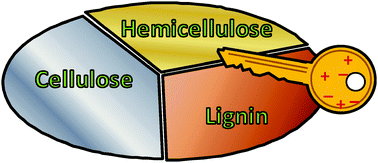
Certain ionic liquids have been shown to dissolve cellulose, other biopolymers, and even raw biomass under relatively mild conditions. This particular ability of some ionic liquids, accompanied by a series of concurrent advantages, enables the development of improved processing strategies for the manufacturing of a plethora of biopolymer-based advanced materials. The more recent discoveries of dissolution of lignocellulosic materials (e.g., wood) in ionic liquids, with at least partial separation of the major constituent biopolymers, suggest further paths towards the achievement of a truly sustainable chemical and energy economy based on the concept of a biorefinery which provides chemicals, materials, and energy. Nonetheless, questions remain about the use of ionic liquids and the advisability of introducing any new process which utilizes bulk synthetic chemicals which have to be made, disposed of, and prevented from entering the environment. In this article, we discuss our own journey from the discovery of the dissolution of cellulose in ionic liquids to the cusp of an enabling technology for a true biorefinery and consider some of the key questions which remain.
Fetching data from CrossRef. This may take some time to load.