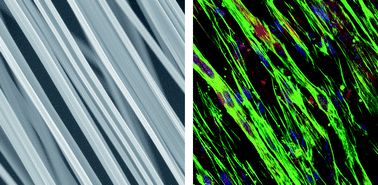
Tissue-engineered nanofibrous matrices can potentially serve as an implantable scaffold for the reconstruction of damaged or lost tissue by regulating cell proliferation, organization, and function. In this study, we developed a polyblend chitosan-polycaprolactone (PCL) nanofibrous scaffold with unidirectional fiber orientation by electrospinning for skeletal muscle tissue reconstruction and investigated the effect of the fiber alignment on cell organization and differentiation in comparison with randomly oriented nanofibers and 2D films of the same material. The chitosan-PCL material was shown to support skeletal muscle cell attachment and proliferation, and the fiber alignment promoted skeletal muscle cell morphogenesis and aligned myotube formation in the nanofiber orientation. Reverse-transcription PCR analyses revealed an up-regulation of differentiation-specific genes, troponin T and myosin heavy chain, in muscle cells on the aligned nanofiber scaffolds, confirming the ability of aligned chitosan-PCL nanofibers to enhance muscle cell differentiation. These results suggest that chitosan-PCL nanofibrous scaffolds with unidirectional fiber orientation can significantly enhanced muscle cell development making it a potential scaffold for enhanced skeletal myogenesis.
You have access to this article
 Please wait while we load your content...
Something went wrong. Try again?
Please wait while we load your content...
Something went wrong. Try again?