This website uses cookies to give you the best user experience. If you continue
without changing your settings we'll assume you are happy to receive all RSC cookies.
You can change your cookie settings by navigating to our Privacy and Cookies page and following the instructions. These instructions
are also obtainable from the privacy link at the bottom of any RSC page.
A journal linking all aspects of the chemical, physical and biotechnological sciences relating to energy conversion and storage, alternative fuel technologies and environmental science.
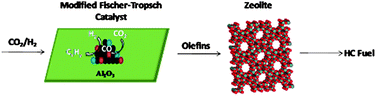
The impact that anthropogenic CO2 is having on the environment has been thoroughly documented over the last 20 years. Many different technologies have been proposed to reduce its impact on global warming such as geological sequestration. However, an interesting and attractive alternative would be the recycling of the gas into energy-rich molecules. Iron rather than cobaltcatalysts, based on the Fischer–Tropsch technology, have shown the greatest promise in converting CO2 to value-added hydrocarbons. The addition of co-catalysts is, however, essential to fine tune the product distribution to the more desired alkene products. The role that both the promoter and support play on the catalyst's activity is reviewed.