


 SCHEDULED MAINTENANCE

Theoretical detection limits of magnetic biobarcode sensors and the phase space of nanobiosensing
Abstract
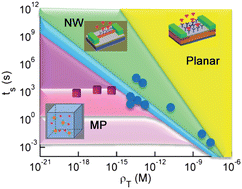
A scaling theory of the sub atto-molar (aM) detection limits of magnetic particle ( ; while for
 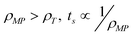 . The theory (i) explains the performance improvement of MP-sensors by
  (order of 103–106), broadly validating the sub-aM detection limits reported in literature, (ii) offers intuitive interpretation for the counter-intuitive ρT-independence of detection time in MP-sensors, (iii) shows that statistical fluctuations should reduce with
 Please wait while we load your content...


